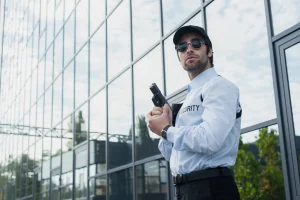
Quick answer: most homeowners associations in Southern California choose between three options: a standing guard at the gate or clubhouse, a roving guard who patrols the community on foot or by cart for a full shift, and a mobile patrol that drives through several times a night. Gated communities with heavy visitor traffic usually need a standing gate guard. Smaller or open communities often get the best value from a mobile patrol, with guards added for pools, events and known problem times.
HOA boards face a hard balance: residents want to feel safe, but every dollar comes from their dues. This guide helps board members and community managers in Orange County, Riverside, Temecula, Chula Vista and across California pick the right level of security and write a contract that delivers it.
What HOA security guards actually do
- Control the gate: check visitors against resident lists, log vendors and deliveries
- Patrol common areas, parking, pools, gyms and clubhouses
- Enforce posted community rules, such as pool hours and parking rules, by reporting violations to management
- Respond to resident calls about noise, suspicious people or open gates
- Check that amenity doors and gates are locked after hours
- Write incident reports the board can use for enforcement or insurance
- Call police or fire and guide them to the right address in an emergency
Guards are not police. In California, a security guard has the same arrest powers as any private person under Penal Code Section 837, and BSIS training on Powers to Arrest teaches guards to observe, report and call law enforcement rather than confront. A good HOA contract makes that clear, so residents know what to expect.
Standing guard vs roving guard vs mobile patrol
Standing (gate) guard
A guard stays at a fixed post, usually the main gate or guardhouse. This suits gated communities with many visitors, contractors and deliveries. It gives the strongest access control and the most visible presence. It is also the most expensive option, because the post must be staffed for every hour it is open.
Roving guard
A guard patrols the whole community on foot, bike or golf cart for the full shift. This suits larger communities with several amenities, or places with problems such as car break-ins, loitering or vandalism. The guard can respond to a resident’s call within minutes.
Mobile patrol
A marked vehicle visits the community at random times through the night, as part of a route that serves several sites. The officer drives the streets, checks gates and amenities, and can be dispatched to resident calls. This gives regular visible presence at a much lower cost. See how mobile patrol security works.
How to choose the right option for your HOA
- Review incident history. Look at police calls, management complaints and insurance claims from the past year. Note what happened, where and when.
- Match coverage to the hours that matter. If most problems happen between 10 pm and 4 am, you may not need daytime cover.
- Look at access points. One controlled gate suits a standing guard. Many open entrances suit patrols plus cameras.
- Add guards for peak times. Pool season, holidays and community events can justify extra hours without a year round post.
- Use technology where it fits. Gate cameras, license plate readers and CCTV monitoring can cover quiet hours, with a patrol sent when something is flagged.
- Ask residents. A short survey shows where people feel unsafe and builds support for the budget.
What to put in an HOA security contract
- The company’s BSIS PPO license number and proof of insurance naming the HOA as additional insured
- Written post orders: duties, patrol routes, gate procedures and what guards must not do
- Response time for resident calls and how calls reach the guard
- Daily activity reports and incident reports sent to the manager
- Rules for guard conduct, uniforms and courtesy toward residents
- A named supervisor and a regular review meeting with the board
- Clear hourly rates, holiday rates and the notice period to change hours
Before you sign, check the company’s license and each guard’s registration on the state’s free lookup.
Keeping security costs fair for homeowners
Security is often one of the largest lines in an HOA budget, so boards should review it every year. Combining a smaller number of guard hours with patrols and cameras often gives better coverage for the same money. Our guide to what security guards cost in California explains how rates are built. For apartment and condo buildings, see the value of onsite security for apartment and condo communities.
HOA security from Barzo Security Services
Barzo provides gate guards, roving officers and mobile patrol for residential communities across Orange County, Riverside, Temecula, Chula Vista, San Bernardino and Los Angeles. We will walk the community with your manager and suggest a plan that fits your budget. Learn more about our security guard services.
Call +1 951 539 7013 (24/7) or request a free HOA security assessment.
Frequently asked questions
Do HOA security guards have the power to arrest?
Security guards in California have the same arrest powers as any private person under Penal Code Section 837. In practice, HOA guards are trained to observe, report and call police rather than detain people.
Can HOA security guards enforce community rules?
Guards can remind residents and guests of posted rules and report violations to management. Fines and other enforcement are decided by the board under the HOA’s governing documents.
Is mobile patrol enough for an HOA?
For many smaller or open communities, yes. Random patrols through the night, plus a guard on call for resident complaints, give regular presence at a lower cost than a full time post.
Do gated communities need a guard at the gate?
Not always. Communities with heavy visitor traffic benefit from a staffed gate. Others use remote gate systems and cameras, with patrols checking the gate area at night.
Should HOA security guards be armed?
Most HOAs use unarmed officers, which suits a residential setting. Armed guards are rare and should only be used after a clear risk assessment.
How often should an HOA review its security contract?
At least once a year, using incident reports, resident feedback and the budget. A good provider will meet the board regularly and suggest changes.
Sources: California Bureau of Security and Investigative Services, Security Guard Fact Sheet; California Penal Code Section 837; Community Associations Institute.